
Flamenco
An indigenous Andalusian tradition that became a national symbol and a global cultural treasure.

A flamenco performance I saw in Seville stayed with me long after the final curtain call. Beyond the immediate joy of watching it, something lingered—an energy, a question, a pull. It made me think, stirred my curiosity, and led me down a path of reading, reflecting, and eventually writing this piece.
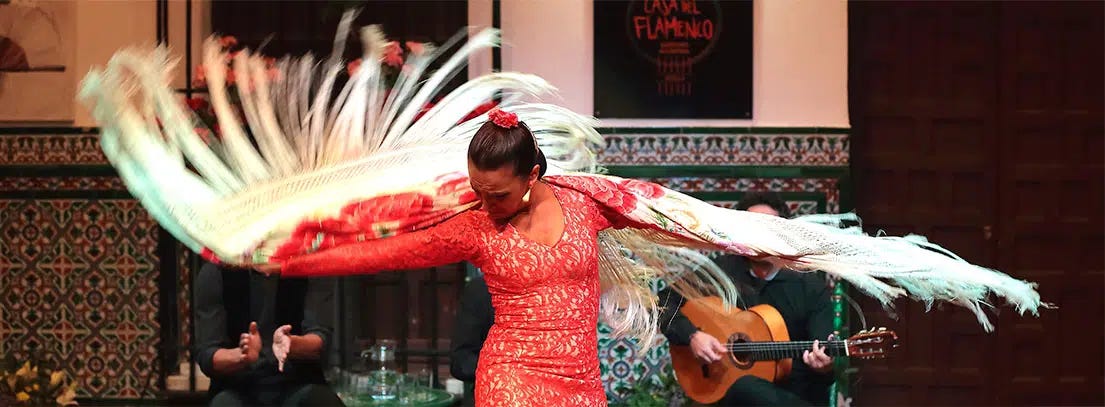
Finding the Rhythm – Duende
Real flamenco is mostly improvisation. It’s a special kind of thrill to watch the performers find the rhythm—as if the music and movement are being discovered in real time.
The dancer leads. The guitarist and singers follow.
The dancer takes the stage. And then... waits. This moment stretches for several long seconds. At the risk of sounding absurd, it reminded me of how long it used to take old modems to connect to the internet—dialling, waiting, retrying—until, finally, a connection was made.
The dancer must first connect—not just with the music or the audience, but with something more mysterious. A force. A spirit.
They clearly have technique, and plenty of it. But in flamenco, technique is only a tool—it is not the performance.
Later, I learned that this moment of connection—of conjuring rhythm and presence—is known as duende. The word has no exact translation, but in flamenco it refers to a supernatural energy, an emotion, a force that lifts the performance beyond skill. It connects artist and audience in a raw, visceral experience.
The Spanish poet and playwright Federico García Lorca explored duende deeply. He famously wrote: "Duende cannot be learned—it must be lived."
Duende is that “something” that makes a flamenco performance unforgettable: a surge of passion, intensity, and truth that technical perfection alone can never deliver.
As the dancer begins to channel duende, the guitarist watches closely, responding in real time—testing a few quiet melodies, abandoning one and trying another, waiting for the moment to land. You are witnessing a dance being born in front of your eyes.
When the dance finally begins, the music bursts forth—exuberant, vibrant, full of energy. The singers, too, must decide if and when to enter. Their contribution is also improvised.
You notice your jaw unclenching. A quiet smile forms. There’s admiration in your chest, joy on your face—and on the faces around you.
The performers seem to be dancing for themselves. It is expression, not performance. They are playing, exploring, enjoying. And like all true artists, they know that when the joy is real, the audience will feel it too.
I was especially moved by the solo dances, whether by a man or a woman. I found myself wondering: is duende at its strongest when the dancer is alone?
There’s something sacred about a single dancer on stage. With no one to follow or match, they are free—free to pause, erupt, take risks. That freedom seems to invite duende more directly. There’s no need to negotiate rhythm or share space. The dancer owns the moment completely. Duets can be powerful too, but they depend on chemistry—and that is harder to find.
Gender and Age in Flamenco
Male and female dancers are equally gifted, though they often move differently. These differences aren’t strict. The old gender roles still echo, but the lines have blurred. Flamenco, like all living art, now makes more room for individuality than convention.
Our male dancer is graceful, expressive. He relies on footwork—zapateado—but his whole body dances. His torso pulses with rhythm, his shoulders respond to the beat. Instead of brooding or showing torment, his face is full of joy. He smiles often, and his connection with the audience is immediate, warm.
He doesn’t have the shawl or long-trained dress to animate the air around him. But he makes his own tools. Dressed in a loose patterned shirt and a fitted jacket, he flicks the jacket’s edges as he moves, giving himself motion and flair. His movements are sharp, surprising. He is masculine, yes—but not in the old way. He’s not there to impress with bravado or technique alone. He’s there to be in the dance.
Traditionally, the woman is seen as the emotive force—expressing sorrow, sensuality, or longing. But our female dancer brought something else. Her upper body moved with authority. Arms, hands, fabric—they cut through the air with purpose. Her presence was intense, almost severe. Unlike the smiling man beside her, she didn’t blink until the curtain fell.
We were lucky to see young dancers. At first, I wondered if they might lack depth. But that thought passed quickly. Their performance felt alive. It had the weight of tradition, but also something new. A spark. As if they were speaking an old language with a modern voice—fluently, freely, and without fear.
Flamenco, Not Just a Tourist Attraction
I wouldn’t normally choose to see flamenco on my own. I’ve long associated it with tourism—something packaged and polished for visitors, a cultural product sold for easy applause. I’ve worried about low-quality imitations, designed more to earn euros than to honour tradition.
But watching this performance shifted something. I began to wonder: how do we protect traditions like flamenco without letting tourism dilute them? How do we share an art form with the world without letting it loose its soul?
This experience made me want to seek out more flamenco—not just to watch, but to understand. To feel, even for a moment, what it might be like to enter that state of duende.
I left with deep admiration for those who keep flamenco alive—young and old. It is more than a show. It is a cultural inheritance. A living practice. And now, for me, no longer just a tourist attraction.
A Layered Andalusian Musical and Dance Tradition
Flamenco is a symbol—one of the first things people imagine when Spain comes to mind. From global stars like Rosalía to local legends like Niña Pastori of Cádiz, the tradition continues to evolve and reach new audiences.
But in Spain, flamenco is unmistakably Andalusian.
It weaves together the multicultural history of Andalusia into a layered, living tradition. It does not erase or exclude. Instead, it fuses Moorish, Jewish, and Romani influences into something uniquely its own—an indigenous Andalusian expression of music and dance.
Moorish music brought complex rhythms and melodic modes—maqams. Jewish traditions added emotional vocal styles, rich with nuance and feeling. The Romani people gave flamenco its most recognisable spirit—its fierce footwork, its intensity, its fire. These are the layers that form its soul.
After 1492, under Catholic rule, these very communities—Moors, Jews, and Romani—were persecuted or expelled. In this context, flamenco became more than art. It became resistance. A voice for the voiceless. Its themes—exile, grief, longing—still echo with that history.
It wasn’t until the 18th and 19th centuries that flamenco stepped out from private gatherings into public performance. The guitar grew in importance. Audiences widened. The art form began to shift.
In the 20th century, flamenco opened itself to other sounds—classical, Latin American rhythms, jazz, even pop. It continued to absorb, adapt, and reinvent.
In 2010, UNESCO recognised flamenco as an Intangible Cultural Heritage of Humanity. A fitting honour—for a tradition built not on permanence, but on movement, memory, and the power of expression.
The Origin of the Word Flamenco
The origin of the word flamenco is still debated. But the romantic in me is drawn to one theory—the idea that it comes from Arabic, perhaps from words meaning “wandering peasant” or “escaped farmer.”
It fits. It feels true to the spirit of flamenco—a tradition shaped by the margins, by the lives of the displaced, the oppressed, the overlooked.
It also feels personally fitting. Don’t we all, at some point, need to wander—away from the familiar, out of our circumstances—to discover something new? To find ourselves, or at least a clearer version of who we are? That’s what I’m doing here in Spain.
Come and visit. You never know what you might find.
—
Andalusia – 5 April 2025
Credits
The flamenco performance that inspired this piece was performed by:
Juan Tomás de la Molía – Male Dancer
Águeda Saavedra – Female Dancer
José Luis Medina – Guitarist
Sora Corea – Vocalist
Marcos Martinez – Vocalist
I saw the performance at La Casa del Flamenco in Seville.
Watch the performers here:
Post Note
While working on this piece, my well-read cousin reminded me of a poem written in 1929 by one of Türkiye’s greatest poets, Yahya Kemal Beyatlı. It was later set to music by the celebrated composer Munir Nurettin Selçuk, and has since been performed by generations of Turkish singers—including the legendary Nesrin Sipahi.
Here is a Spotify link to the song if you’d like to listen.
There’s something about this piece—in its classical Turkish musical form—that lifts me out of Türkiye and gently lands me in Andalusia.
Below is the original poem, along with a direct, literal English translation (as I couldn’t find a version by a literary translator):
ENDÜLÜSTEKİ RAKS (The Dance in Andalusia)
by Yahya Kemal Beyatlı
Original Turkish:
Zil, şal ve gül.
Bu bahçede raksın bütün hızı
Şevk akşamında Endülüs üç defa kırmızı
Aşkın sihirli şarkısı yüzlerce dildedir
İspanya neş’esiyle bu akşam bu zildedir
Yelpaze çevrilir gibi birden dönüşleri
İşveyle devriliş, saçılış, örtünüşleri
Her rengi istemez gözümüz şimdi aldadır;
İspanya dalga dalga bu akşam bu şaldadır
Alnında halka halkadır aşüfte kâkülü
Göğsünde yosma Gırnata’nın en güzel gülü
Altın kadeh her elde, güneş her gönüldedir
İspanya varlığıyla bu akşam bu güldedir
Raks ortasında bir durup oynar, yürür gibi
Bir baş çevirmesiyle bakar öldürür gibi
Gül tenli, kor dudaklı, kömür gözlü, sürmeli
Şeytan diyor ki, sarmalı, yüz kerre öpmeli
Gözler kamaştıran şala, meftun eden güle,
Her kalbi dolduran zile, her sineden: “ole!”
Dance in Andalusia (Literal Translation)
Bell, shawl, and rose.
In this garden, the dance is at full speed.
In the thrill of the evening, Andalusia is red three times over.
The magical song of love is in hundreds of tongues.
With Spain’s joy, tonight, it is in this bell.
Their sudden turns are like the flip of a fan.
The way they sway with coquetry, scatter, then cover—
Our eyes want no other colour; they are dazzled.
Spain, wave upon wave, is tonight in this shawl.
On her forehead, her flirty bangs form circles within circles.
On her chest, the most beautiful rose of coquettish Granada.
A golden goblet in every hand, the sun in every heart—
With all its essence, Spain is tonight in this rose.
In the middle of the dance, she pauses—as if to walk,
With a turn of her head, she looks—as if to kill.
Rosy-skinned, ember-lipped, coal-eyed, lined with kohl—
The devil whispers: embrace her, kiss her a hundred times!
To the shawl that dazzles, to the rose that enchants,
To the bell that fills every heart, from every chest: “¡Olé!”
Bravo. Succesfully Noticed about the different part of hummanity over Our World. We are the world slogan iş smilar to this very interesting articel for being human. Thank You, as an influencer in Spain. You are a little big philosoph Mediterrain people
A friend sent me a direct message: "Flamenco feels improvised, but it actually follows structured rhythmic and melodic forms, known as palos. There's definitely space for expressive spontaneity, but it's all happening within a precise framework—almost like jazz in that way." She added, "Traditionally, it's the singer (cante) who leads, not the dancer. The voice sets the emotional and rhythmic tone, and both the guitarist and dancer respond to it."
In the story above, I recounted the performance we saw, which began with the explanation that what we were about to witness was 90% improvisation. From my perspective, it was the dancer who seemed to be leading the musicians. This made sense in the context of entering the state of duende.
Just to clarify: I’m not making a general statement about flamenco—only reflecting on what I observed in that particular performance.