
We, the peoples
Human rights, fear, and the moral test of universality.

I read the Universal Declaration of Human Rights (UDHR) yesterday.
It is one of the best texts ever written. I have read it twice. I have been thinking about it non-stop since then. So I decided to write about it, in the hope that it stays with me longer. I do not want it to leave me. It is very important.
It basically says we are all equal. This equality is not restricted to an elite, lucky few. Regardless of where we were born, our race or religion or our sexuality, we are born free and equal.
Further, we have several rights. All of us. Not a select few who got lucky with the geography of where they were born, the family they were born into, or the schools they attended.
The UDHR gives us the right to education, to fair wages and social security, and to an adequate standard of living — food, housing and healthcare. It grants us freedom of thought, peaceful assembly and association, and the right to seek asylum. It protects us from slavery, torture and cruel treatment. It has provisions against discrimination of any kind.
The last article in the UDHR is so important that we should read it again and again until it is embedded in our heads: No one may use these rights to destroy the rights of others.
So clear. So elegantly written. So important.
The Universal Declaration of Human Rights was adopted by the United Nations in 1948, after the atrocities of World War II. It sets out fundamental rights and freedoms that belong to every human being, regardless of nationality, race, religion or status — meaning our social position, wealth or background — in 30 articles.
The UDHR is universal. What a beautiful word universal is. It levels us.
Having said that, not everyone agrees that rights are universal. Some traditions place more emphasis on duty than on individual freedom. Yet the UDHR did not emerge from a single civilisation or philosophy. It was shaped by voices from Asia, Europe and the Americas. That matters. It reminds us that human dignity is not the property of one culture.
I do recall reading about the UDHR in primary school. But I remember neither its specifics nor any major discussion about it in the decades since. Reading it now, in our current geopolitical context — destruction caused by multiple wars and threats, and ongoing inequality across the globe — this 78-year-old text feels so relevant.
So I wish to encourage everyone to read it, think about it, and share it with friends and family.
Here is the link:
https://www.un.org/en/about-us/universal-declaration-of-human-rights
Regardless of the complexity of the problems that surround us — especially wars — I believe our starting point must be this: as humans, we all have a right to exist, and we cannot deny those rights to others.
That sounds simple. Yet perhaps the hardest moral task in the world is to hold on to that principle when fear takes over, when we feel threatened, wounded or afraid. That is when entire nations, not just individuals, begin to make exceptions for themselves.
Two recent experiences led me to read the UDHR
2025 CBC Massey Lecture Series: Renewing Human Rights in a Fractured World
I listened to these lectures by Alex Neve, Canadian human rights activist and lawyer, as he examined the history of human rights and explored why he believes universal human rights are achievable.
He takes us through the ideals behind the concept — the sacredness of life, reciprocity, justice and fairness — and details the historical context that led to the declaration of the UDHR. He also offers hope for resolving the issues in our fractured world.
Anyone concerned about current global affairs — which, given the state of affairs, I believe should be all of us — and anyone interested in history, social justice and equality, would enjoy and benefit from these lectures.
https://www.cbc.ca/radio/ideas/cbc-2025-massey-lectures-alex-neve-9.6974336
Conversations with an Israeli couple
I am patiently waiting in a queue to purchase tickets for Villa Borghese in Rome. It is about 12:30. The attendant tells us that entry tickets are sold out for the next three weeks. On the hour, depending on how busy the gallery is, they sometimes offer extra tickets.
I am number fifteen in the line. She draws the line at twelve — those people may get tickets at 13:00. I will have to wait about an hour and a half to get in. I had dedicated the day to Bernini’s sculptures — some of his most famous works, such as Apollo and Daphne at Villa Borghese.
A couple in their early thirties join the queue. They speak a language I cannot immediately identify.
He asks me about the availability of tickets. I explain an abbreviated version of the situation in simple English. I ask him what they are looking forward to seeing at the gallery.
“Nothing specific,” he says, and then shares his story. They are stuck in Europe. Due to air traffic closures, they cannot return to Israel. They were on a short holiday in Europe. They have a young daughter, left with one of their parents.
They look tired.
The man suggests to his wife that she sit on the bench across from us while he waits in line. By then, more people have joined behind him. I suggest he could also go and rest, and that I would save his spot. He declines.
I think quickly that they must have been bombarded with questions about the Gaza conflict and the outbreak of war with Iran during their trip. I decide to avoid the subject. Instead, I begin telling him about Bernini and the works in the gallery.
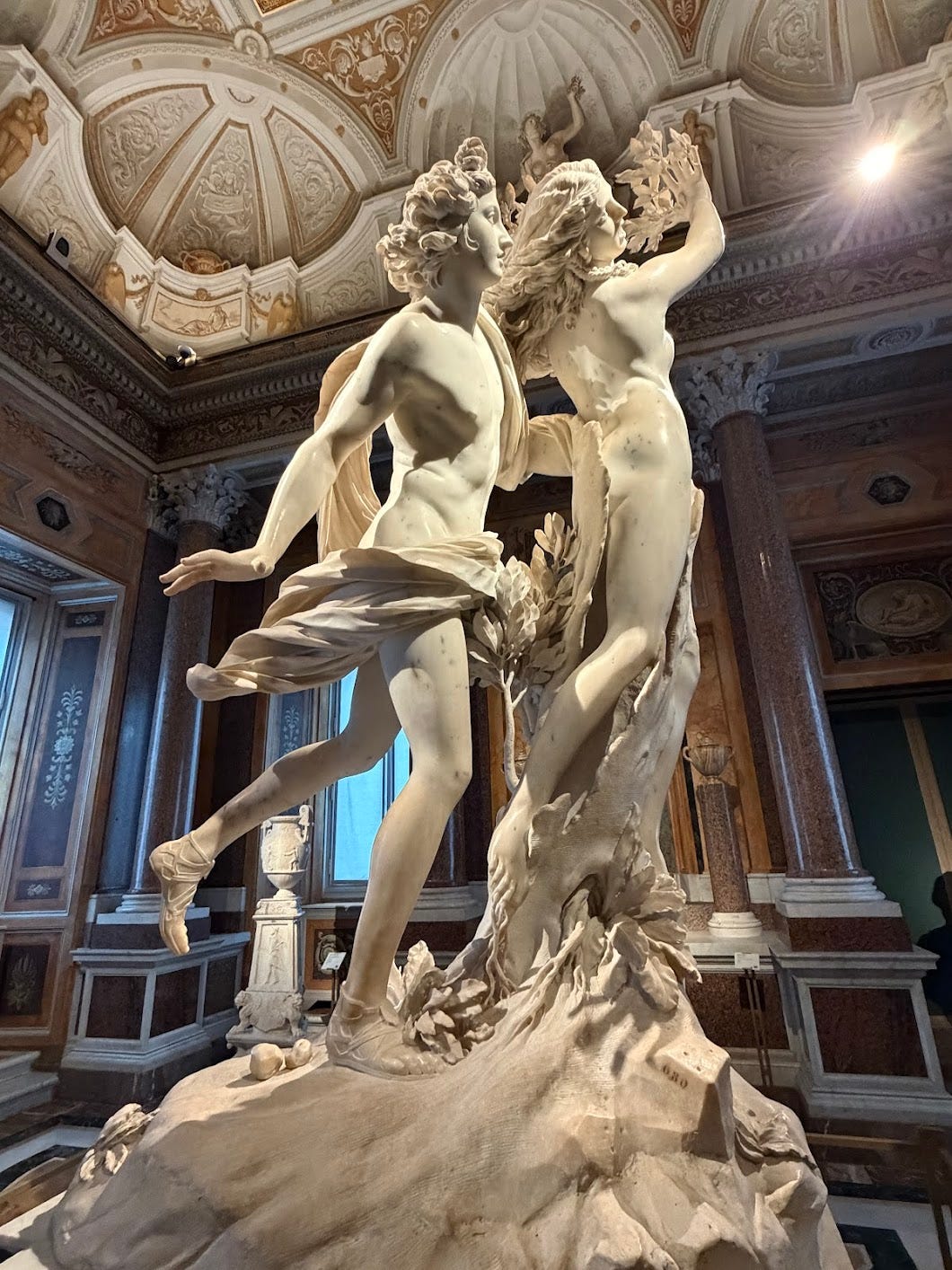
He is interested, but soon discloses that he does not know much about art. He works in venture capital and spends his days behind a computer, building mathematical models.
I change the subject to Israeli entrepreneurship.
Later he shares that both of his parents were born in Israel — his father’s family descended from Türkiye, his mother’s from Iraq. We connect on this subject too.
I ask him about the Israeli singer Yasmin Levy, who sings in Ladino — a Judeo-Spanish language spoken by Sephardic Jews in Türkiye, originating from Old Castilian Spanish following their expulsion from Spain in 1492.
We connect on so many fronts — art, business, culture, land. I like him.
His wife is still sitting on the bench.
Eventually, I ask him what average people in Israel think about the war with Iran.
He responds quickly:
“We fight for our existence.”
It takes me a few seconds to process this statement. It is a delicate matter. I am fond of my newly acquired friend. He is obviously a decent person, and I am enjoying the conversation. The last thing I want to do is upset him further when he is stranded away from home.
The first thought that comes to my mind is that this must be how the Israeli regime justifies war. It is an easy sell. This is existential.
But that is precisely the problem. Once a conflict is framed as existential, fear begins to override moral recognition. Empathy narrows. Rights become conditional. And what is universal in principle starts to become tribal in practice.
After a long pause — one in which I am clearly deep in thought — I say:
“You have a right to exist. We all do. The people in Iran and Palestine do as well.”
I sense an unintended tension building between us, which I had wanted to avoid from the beginning. Yet I continue:
“This should be our starting point. We cannot reserve these fundamental rights and freedoms for ourselves and deny them to others.”
He responds with several sentences in quick succession — about undemocratic regimes in the region, threats, fear, instability. A little incoherent, but revealing. It shows how wars break out and endure when fear overrides moral recognition of the rights of others.
He is tense. I feel it.
At that very moment, fortunately, the attendant interrupts us to say that tickets are now available and that we can go in.
I do not know exactly what thoughts I left my new friend with. But I sincerely hope that he and his wife were safely reunited with their young daughter and their families in Tel Aviv. They were planning to fly to Alexandria, Egypt, the next day and attempt a land crossing into Israel.
This conversation took place on 6 March, seven days after Israel and the United States struck Iran.
That same day — highly stimulated by the beauty of the art and the warmth of the conversation — I overhear a beautiful tune on the street while walking. I move towards the sound.
There, I witness Iranians marching along a street in Rome — a small group, mostly young women. Their physical features could allow them to blend in anywhere along the Mediterranean coast, from Türkiye to Spain.
They carry Iranian, Israeli and American flags.
They seem hopeful about their homeland after 47 years under the current Islamic regime.
Let us all read the Universal Declaration of Human Rights. Let us listen to Alex Neve’s lectures to find hope and solutions.
There is urgency in this. Civilians are being sacrificed in wars everywhere, and destruction wipes away our collective civilisation. New tensions are being generated that will become a heavy legacy for future generations to resolve.
The title of this post is borrowed from the opening words of the UN Charter, adopted in 1945:
“We, the peoples of the United Nations, determined to save succeeding generations from the scourge of war …”
Systems thinking teaches us how to deal with complex situations. It suggests identifying one rule, expectation or default that shapes behaviour — and adjusting that.
I am thinking hard that it may be as simple, and as difficult, as this: accepting, understanding and applying the idea that, as humans, we all have a right to exist, and we cannot deny those rights to others.
If that became the default assumption — not only in private morality, but in policy, diplomacy and public narrative — much else would begin to shift. The question asked in every conflict would no longer be, whose fear counts more? but how do we protect the dignity and existence of all?
That is not sentiment.
That is system design thinking applied to ethics.
Impressive,