
Once We Were Romans
When a quarter of humanity lived under one empire — and what that might tell us about identity today.

My DNA test says I am 5% Italian.
At first, I assumed this meant an Italian ancestor somewhere in my family tree — perhaps four or five generations back.
But genetics is not that precise. DNA percentages do not point to a single identifiable ancestor but to inheritance across generations.
So the connection could be much older.
And that thought led me somewhere unexpected.
Perhaps the connection goes back to a time when a quarter of the world’s population lived under Roman rule.
When a Quarter of Humanity Was Roman
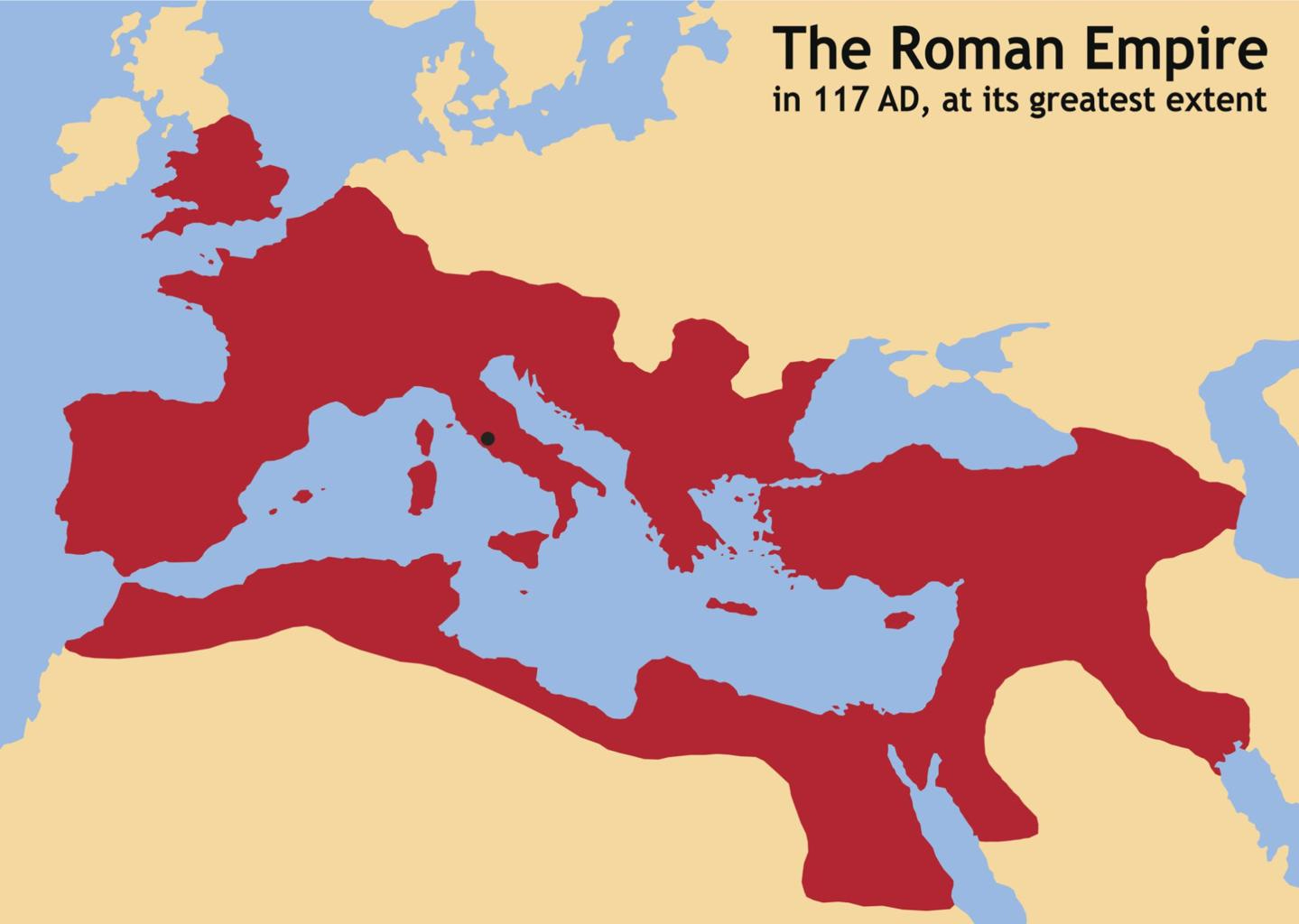
At its peak in the second century AD, the Roman Empire ruled roughly 60 million people — around one quarter of the world’s population at the time.
The empire stretched across an extraordinary geography:
from Spain to Armenia (about 5,000 kilometres), and from Britain to Egypt (about 3,000 kilometres).
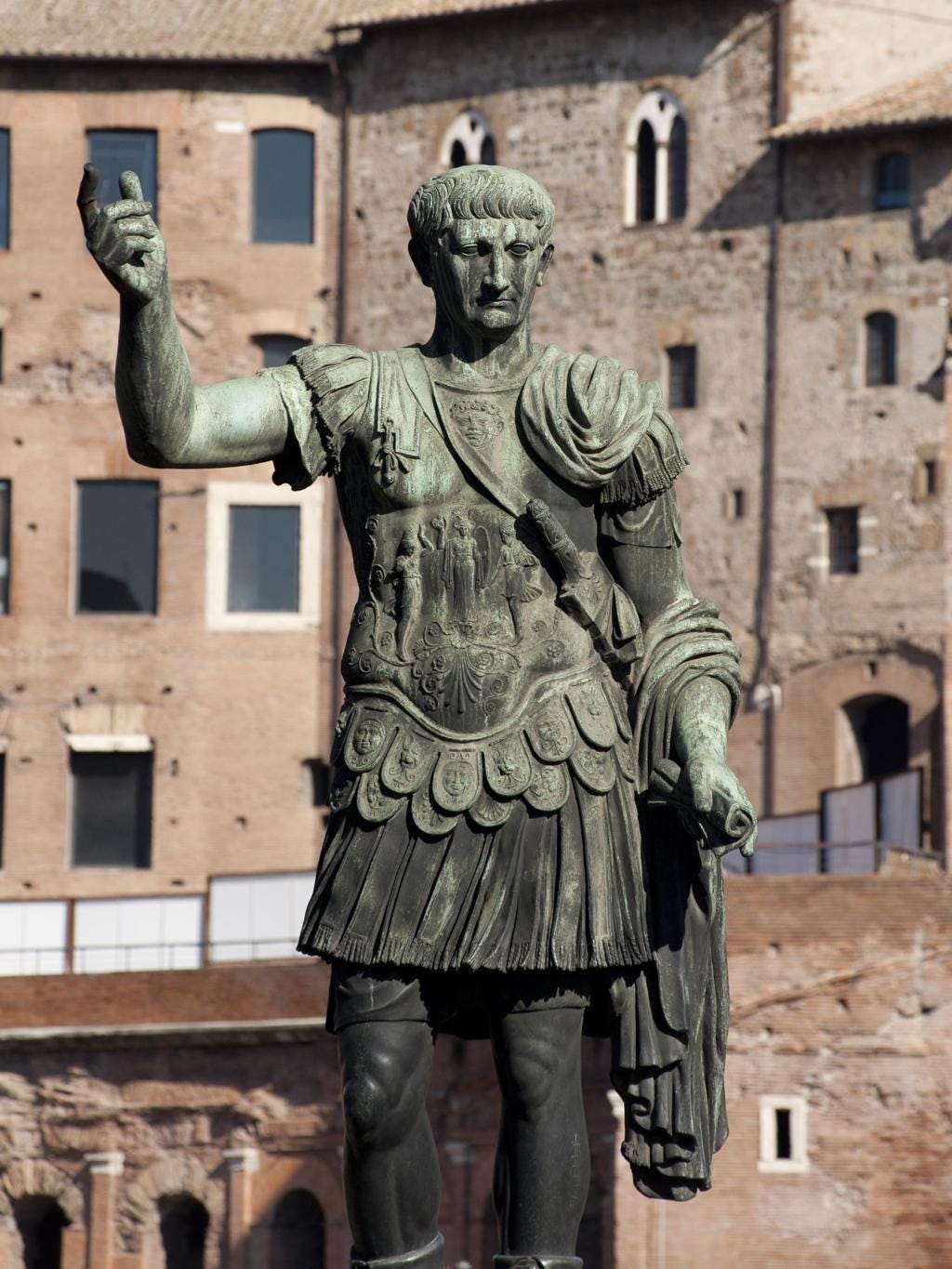
Under Emperor Trajan (AD 98–117), the empire reached its greatest territorial extent.
For the first and only time in history, the entire Mediterranean Sea lay within a single empire.
The Romans called it Mare Nostrum — “Our Sea.”
Imagine the scene.
Ships moved constantly across the Mediterranean carrying grain from Egypt, marble from Greece, wine from Italy and olive oil from Spain. Roads stretched across continents. Soldiers, merchants, officials and travellers moved between provinces that today belong to dozens of different countries.
This was long before airplanes or trains. Most people travelled on foot. Some rode horses.
Yet geography did not prevent ambition.
Both Trajan and his successor Hadrian were born far from Rome itself, in Italica, near modern Seville in Spain. From this provincial town they rose to rule the largest empire the world had yet seen.
The Second Rome
As the empire grew, governing such vast territories from a single capital became increasingly difficult.
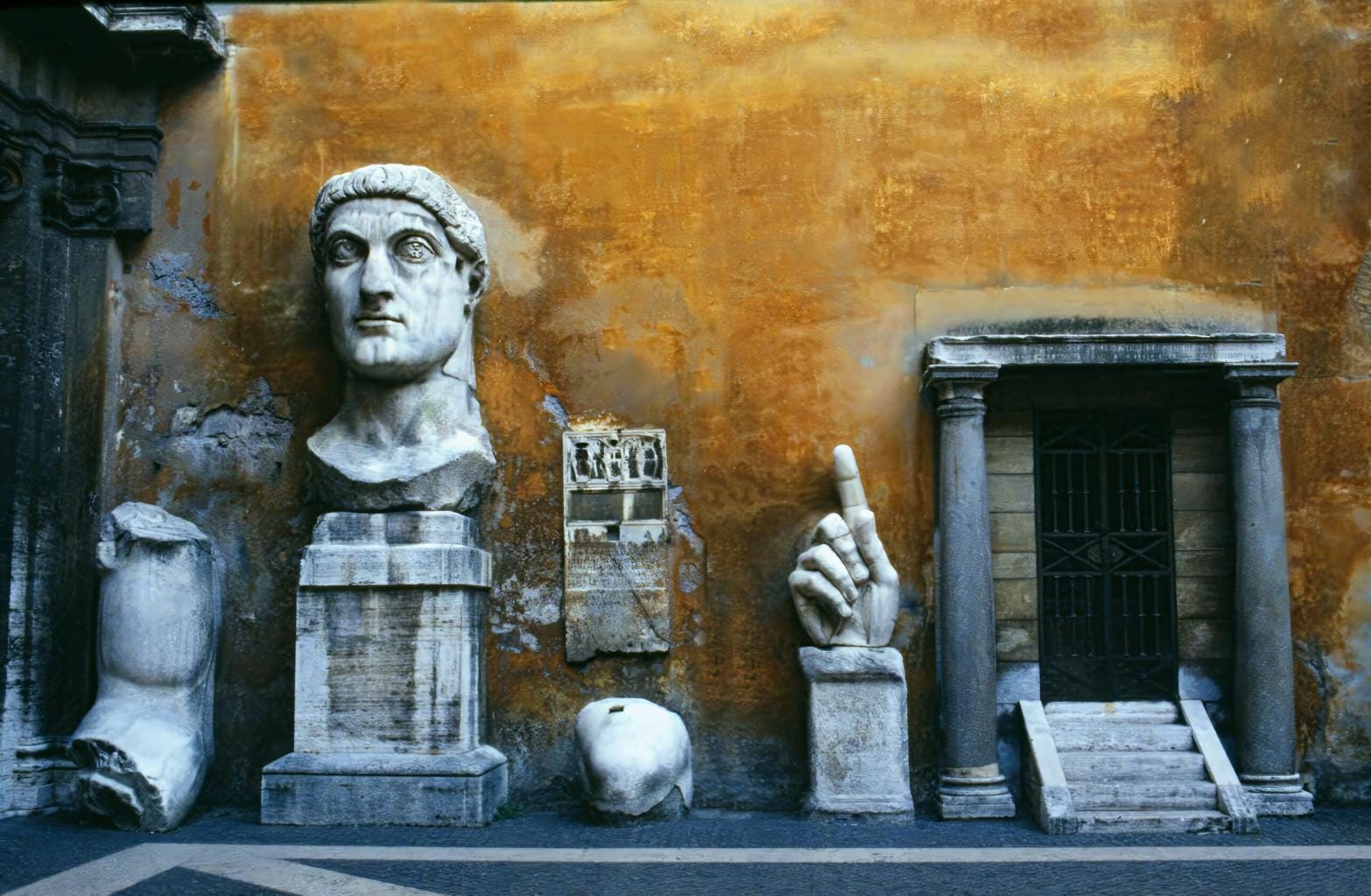
In AD 330, Emperor Constantine the Great established a new imperial capital in the eastern part of the empire.
The city was built on the site of the ancient Greek town of Byzantium, and Constantine formally named it Nova Roma — New Rome.
Soon, however, people began calling it Constantinople, the City of Constantine.
Today we know it as Istanbul.
Constantine also transformed the relationship between the Roman state and Christianity. In AD 313, the Edict of Milan granted Christians freedom to practise their religion after centuries of periodic persecution. He gathered bishops in AD 325 at the Council of Nicaea, held in Nicaea (modern İznik in Türkiye), to settle theological disputes within the Christian world.
Later, in AD 380, under Emperor Theodosius I, Christianity became the official religion of the Roman Empire.
What It Meant to Be Roman
One of Rome’s most remarkable inventions was citizenship.
Unlike many ancient empires that ruled through strict ethnic hierarchies, Rome gradually allowed people from across its territories to become Roman citizens.
Citizenship meant legal protection, the right to trade and marry under Roman law, and in some periods the right to participate in civic life.
Over time, this status expanded far beyond the Italian peninsula.
In AD 212, Emperor Caracalla issued the Constitutio Antoniniana, granting Roman citizenship to almost all free inhabitants of the empire.
Millions of people from Britain to Syria suddenly became Romans.
Rome was not just an empire of territories.
It increasingly became an empire of shared legal identity.
Cities That Survived Empires
At its peak, the city of Rome itself had roughly one million inhabitants, making it one of the largest cities in the world.
Another metropolis of comparable scale was Chang’an, capital of the Han dynasty in China (modern Xi’an).
Rome, however, never disappeared.
Instead, it rebuilt itself repeatedly across centuries, layering new structures over old ones.
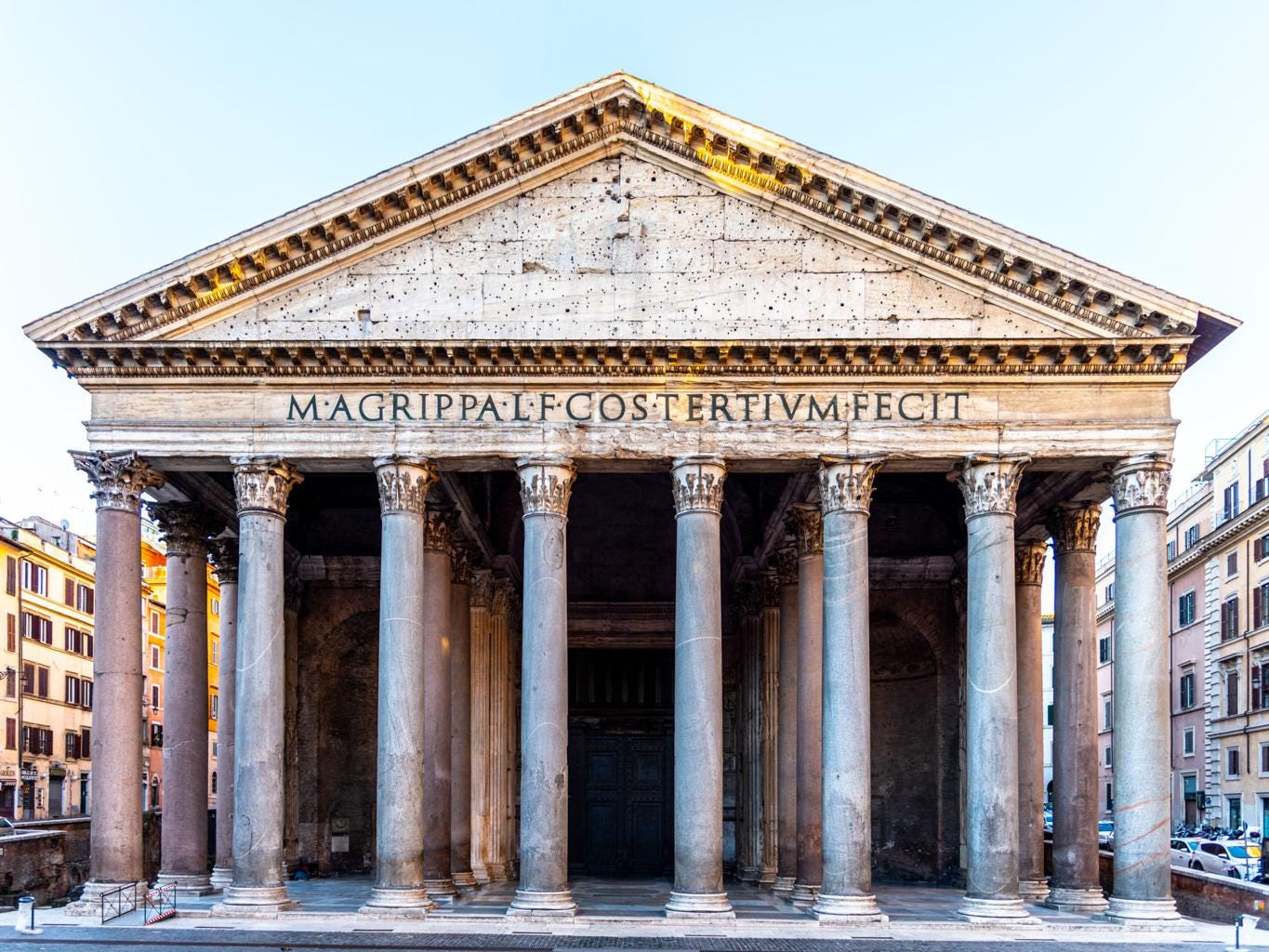
The Pantheon, first built in 27 BC by Marcus Agrippa, was rebuilt in its current form around AD 118–125 under Emperor Hadrian.
St Peter’s Basilica was first constructed in AD 326 under Constantine. The magnificent Renaissance basilica we see today was built between 1506 and 1626.
In Constantinople, another monumental structure appeared in AD 537: the Hagia Sophia, built under Emperor Justinian I. For nearly a thousand years it remained the largest cathedral in the world.
Rome itself also underwent a dramatic architectural transformation under the Emperor Augustus (27 BC – AD 14). He famously said:
“I found Rome a city of brick and left it a city of marble.”
Marble arrived from across the empire:
Carrara marble from Italy
Green marble from Greece
Porphyry from Egypt
Yellow marble from North Africa
Even the massive granite columns at the entrance of the Pantheon were quarried in Egypt and transported across the Mediterranean — an astonishing engineering achievement for the ancient world.
When Did Rome End?
Historians traditionally say the Western Roman Empire ended in AD 476, when the last western emperor, Romulus Augustulus, was deposed.
Yet the empire did not truly disappear.
Its eastern half, governed from Constantinople, continued for nearly another thousand years.
This Eastern Roman Empire finally fell in 1453, when the Ottoman Sultan Mehmed II conquered Constantinople.
Centuries later, scholars began calling this state the Byzantine Empire, after the ancient town of Byzantium.
But during its own existence, its inhabitants never used that name.
They called themselves Romans.
Latin was the empire’s official administrative language. By the seventh century, however, Greek had replaced it, reflecting its widespread use in the eastern provinces.
The Scale of States and the Question of Identity
Reading about the Roman world raises an interesting question.
How much does the political authority governing the land we live in actually define who we are?
Throughout history the same populations have lived under many different rulers.
The writer Sabahattin Ali, for example, who was recently rediscovered by new generations of readers for his novels such as Madonna in a Fur Coat and The Devil Within was born in the Ottoman Empire and died in the Republic of Türkiye.
Yet his birthplace — Eğridere, today Ardino in Bulgaria — remained the same town.
Only the administrative ruler changed.
Human history seems to move between large empires and smaller nation states.
Today we place enormous importance on passports, borders and national identities. Yet history reminds us that these structures are rarely permanent.
Empires rise and fall.
Borders move.
The people remain.
And perhaps that is the most intriguing thought of all: that somewhere in the long chain of migrations, marriages and movements across centuries, many of us today might quietly carry fragments of a world where, quite simply,
once, we were Romans.
Postscripts
For the curious reader, my DNA test suggests that my ancestry is predominantly from the Balkans and West Asia. These results are reasonably reliable for the past couple of centuries, but beyond that, the region’s long and layered history makes certainty difficult. It is entirely possible that my ancestors came from many places, carrying different identities across time and borders.
This story is not about glorifying the Romans — far from it. Life in those times was harsh. Slavery was widespread, emperors could be erratic and self-indulgent, and women had limited rights or voice. The list is long.
Rather, this piece is an attempt to share historical observations I have found interesting — and to raise a broader question: what determines our geographic identity? Is it the governing body, the administrators of the land, or something deeper? And how important is that identity, given how much emphasis is placed on it — often to the point of conflict, as we continue to see in regions such as the so-called Middle East, or more accurately, Western Asia.
If you enjoyed this post, you might also like
Genetic Continuity — a reflection on how the gene pools of modern-day Türkiye connect to Neolithic populations who lived in the region over 11,000 years ago.
https://everydaymuse.substack.com/p/the-story-in-our-genesIncreasing Defence Spending (a.k.a. Militarisation) — written nearly a year ago, but perhaps even more relevant today as conflicts continue to unfold in the Middle East.
https://everydaymuse.substack.com/p/increasing-defence-spending-aka-militarisation